There is a neatness to the Bible. It has 2 testaments and 66 books all collated together by genre. Our translations even have chapters and verses so I can find things. In fact, I can test myself every morning with an app that gives me the verse and I need to guess the reference.
The Bible even has a story line that makes sense: God created the world, we rejected that order, God worked through a particular nation called Israel until he fulfilled the promises he made through the coming of Jesus. Now we have a new covenant to live under until Jesus returns and ushers in the new creation. There are key passages and signposts in the Bible that show when these turning points are occurring.
We like our Bibles clean. We want the Old Testament to stay neatly locked in its ‘history and law’ box and the New Testament to arrive perfectly packaged in a ‘Jesus and salvation’ box. We expect the linear journey: Step 1: Creation, Step 2: Old Testament, Step 3: New Testament and Step 4: New Creation.
But have you noticed? The Bible isn’t clean. It refuses to play by those nice, neat rules all the time. Every so often something appears where it doesn’t belong. For example Daniel 3:25 talks about seeing 4 men when only three were put in the furnace. The other man looks like a Son of Man. If we were reading this in the New Testament it would make perfect sense: Jesus is the Son of Man, he would be with the people who were being persecuted. At first when we see these things we assume that a mistake has been made or we have misunderstood something, perhaps there is a cultural nuance that we are missing.
Or maybe the mistake we are making is that we think the Bible is more neat than it is.
Imagine for a moment that different parts of the Bible had different colours. For example, creation is yellow and the Old Testament is red, the New Testament is blue and new creation is green. The association of the colours is completely arbitrary and the divisions I have created could be more but this is enough to make my point.
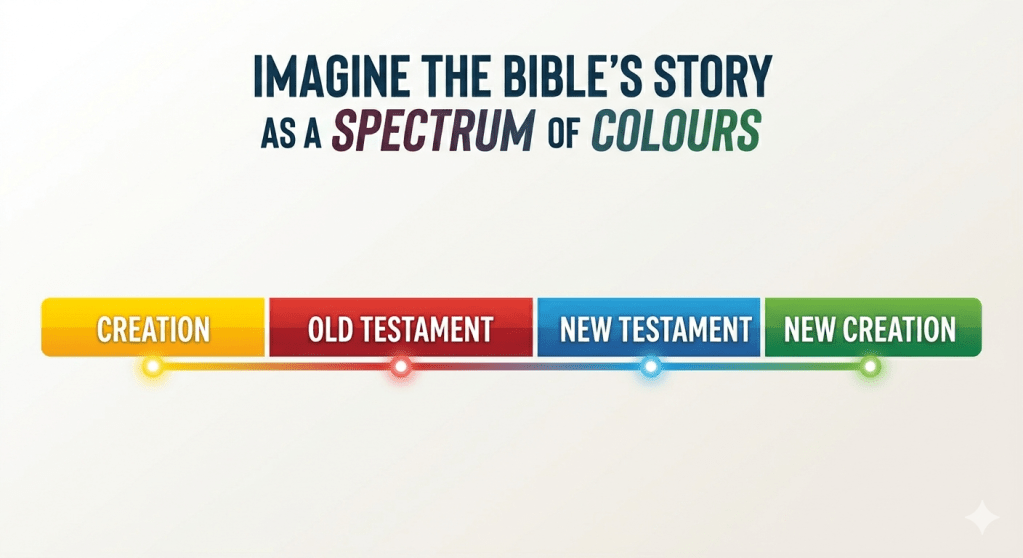
As much as we would like the Bible to be nice and neat and stick to the rules, it doesn’t. The Bible isn’t nice and neat. It is something that creates a colourful canvas. So imagine those colours as the background for the canvas. You will see different dots on the canvas that belong somewhere else. We have already mentioned Jesus making a cameo in Daniel 3, which he does from time to time in the Old Testament. It would like like a blue dot standing out on a red canvas. Or, for example, John the Baptist is more of an Old Testament prophet (Mal 4:5), and yet he finds himself in the New Testament (Matt 3:1-4, 11:11-13). He is a red dot on the blue canvas. Another example is the miracles that Jesus performs, they belong to the new creation, the kingdom that is coming and breaking into the present age. They are green dots on the blue canvas. I am sure you are already thinking of more.
It doesn’t mean that the structures and the storyline of the Bible (what we call Biblical theology) aren’t there. They are. But the point is that at times we need to make a distinction between where something is in the Bible and where it belongs.
All this is really important for, say, working out the role of the Spirit (which is a project I happen to be working on). This is an exercise in systematic theology where we gather together the information for a topic and systematise it. The problem is that if we merely gathered every reference in the Bible without thinking about where things belong we will end up with a slanted view of what we expect.
The age of the Spirit is the New Testament. This was part of the age that Joel 2:28-32 and Ezekiel 36:26-27 expected in the future. But, like Jesus, he creates these little cameos and little roles for himself, so to speak, in the Old Testament (e.g. Ex 31:3, Num 11:24-30). The Spirit belongs in the New Testament with the new covenant but he appears in other places in the Bible.
Systematic theology is about making nice and neat categories that help us understand what is being said. Biblical theology shows that the categories are not as nice and neat as we would like them to be.
This is an important distinction to make as we work out our doctrines of the Bible. We cannot merely be thinking what the Bible says about something, we need to think about where it belongs as well.

