We like our Bibles clean. We want the Old Testament to stay neatly locked in its ‘history and law’ box and the New Testament to arrive perfectly packaged in a ‘Jesus and salvation’ box. We expect a linear journey: Step 1: Creation, Step 2: Old Testament, Step 3: New Testament and Step 4: New Creation.
But have you noticed? The Bible isn’t clean. It refuses to play by those nice, neat rules all the time.
Imagine for a moment that different parts of the Bible had different colours. For example, creation is yellow and the Old Testament is red, the New Testament is blue and new creation is green. The association of the colours is completely arbitrary and the divisions I have created could be more but this is enough to make my point.
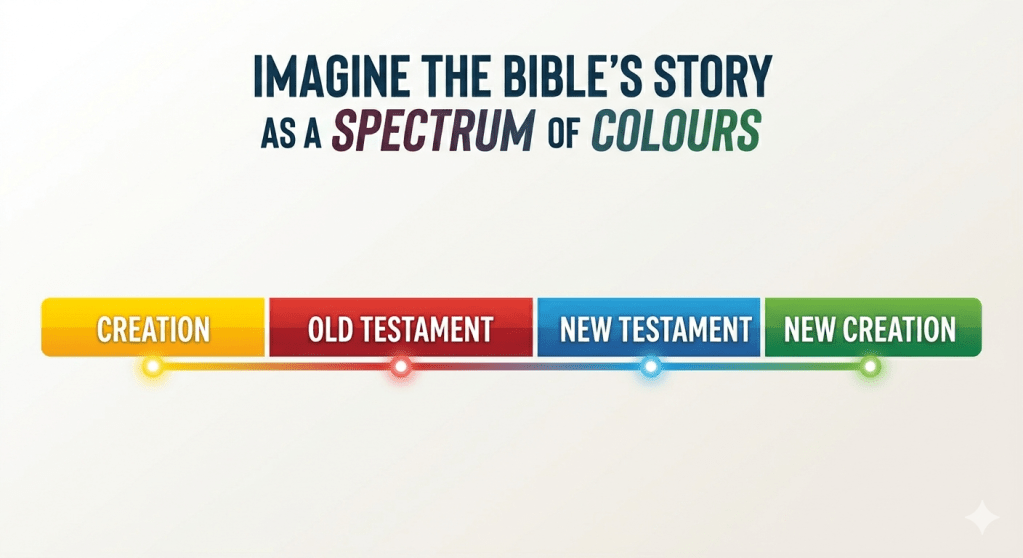
As much as we would like the Bible to be nice and neat and stick to the rules, it doesn’t. The Bible isn’t nice and neat. It is something that creates a colourful canvas. So imagine those colours as the background for the canvas. You will see different dots on the canvas that belong somewhere else. For example, John the Baptist is more of an Old Testament prophet (Mal 4:5), and yet he finds himself in the New Testament (Matt 3:1-4, 11:11-13). He is a red dot on the blue canvas. Another example is the miracles that Jesus performs, they belong to the new creation, the kingdom that is coming and breaking into the present age. They are green dots on the blue canvas. Jesus does not come to the New Testament and yet sneaks in a few cameos in the old Testament (e.g. Dan 3:25).
The point is that there is sometimes a distinction between where something is in the Bible and where it belongs.
All this is really important for, say, working out the role of the Spirit, which is a project I happen to be working on. The age of the Spirit is certainly in the New Testament. This was part of the age that Joel 2:28-32 and Ezekiel 36:26-27 expected in the future. But like Jesus he creates these little cameos and little roles for himself, so to speak, in the Old Testament (e.g. Ex 31:3, Num 11:24-30).
Systematic theology is about making nice and neat categories that help us understand what is being said. Biblical theology shows that the categories are not as nice and neat as we would like them to be.
This means as cannot merely examine the role and work of the Spirit but looking at every passage of the Bible and giving it equal weight, but rather we need to look at where things belong as well as where things occur. The same could be said for all the doctrines we have.
 Peter D Hughes