Knowing Where You Are in the Lifecycle
It matters enormously to know where you are in the lifecycle of anything. Trying to teach algebra to a three-year-old is not a failure of content. It is a failure of timing. You are applying the wrong expectations to the wrong stage of development.
Churches have life cycles. Church plants have life cycles. In fact church plants have life cycles within those cycles. And if we do not understand where we are, we will invest energy in the wrong places, demand outcomes prematurely, or cling to practices that no longer serve us.
There are a number of tools for thinking about organisational lifecycles1. One of the most helpful is the Competing Values Framework developed by Kim Cameron and Robert Quinn2. While originally designed for corporations, it provides a useful lens for church planters seeking to understand culture, leadership, and organisational focus over time.
Let me summarise the framework.
The Model
The framework operates along two axes:
- Internal focus ↔ External focus. One has the organisation facing inwards on its culture and way it does things. At the other end of the axis is outwards towards the market or world looking at how does the organisation fit, contribute or compete.
- Flexibility ↔ Stability. The other axis looks at the flexibility: the ability to adapt, change and innovate compared to the stability of the organisation: the ability to deliver, be predictable and stable.
These two axes create four quadrants, each describing a distinct organisational emphasis:
- External + Flexible = Adhocracy (Creative)
- Internal + Flexible = Clan (Collaborate)
- Internal + Stable = Hierarchy (Control)
- External + Stable = Market (Compete)
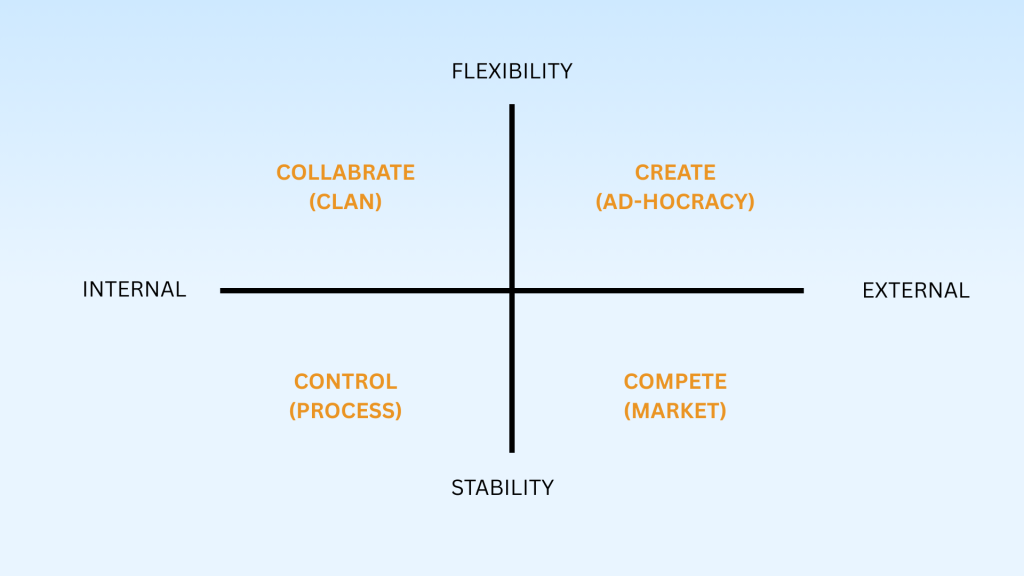
Each quadrant reflects a legitimate mode of organisational life. None is inherently superior. The question is not which is best — but which is required in a given season.
1. Adhocracy (External + Flexible)
Adhocracy is about innovation and responsiveness.
“The root of the word adhocracy is ad hoc-implying something temporary, specialized, and dynamic. Most people have served on an ad hoc task force or committee that disbands as soon as its task is completed. Adhocracies are similarly temporary. They have been characterized as “tents rather than palaces” in that they can reconfigure themselves rapidly when new circumstances arise.”3
Cameron and Quinn note that the word comes from “ad hoc” — something temporary, specialised, dynamic. They describe these organisations as “tents rather than palaces,” able to reconfigure quickly when circumstances change.
Most organisations do not live permanently in this quadrant. But they enter it when creativity and rapid adaptation are required. NASA, during Apollo 13 mission, is a classic example. What began as a planned mission quickly became a rescue operation.
Some organisations intentionally cultivate this culture. Netflix, for example, has consciously leaned into flexibility and reinvention as a core strength4.
Most organisations start here. Apple was is a good example of the story of the life cycle of an organisation. It started with Jobs and Wozinack working out of a garage.
“As is typical of most other adhocracies, a single entrepreneurial, charismatic leader was setting the direction and the company was flexible and freewheeling. The press described the group as “renegades and crazies””5
Trying to impose heavy procedure at this stage will suffocate the work.
2. Clan (Internal + Flexible)
As innovation gains traction, attention shifts inward.
“Shared values and goals, cohesion, participativeness, individuality, and a sense of “we-ness” permeated clan-type firms. They seemed more like extended families than economic entities”6
Identity formation becomes critical. Culture is forged. Language develops. Stories are shared. The “we” becomes stronger. Many start-ups — and many church plants — thrive in this stage. Energy remains high, but it is relational glue that holds the group together.
As Apple succeeded and innovated it, it grew. More people were needed in the team to keep not just the company but the movement of personal computing going.
“Apple established on of the most successful ventures ever experienced in the industry – the formation of a group of “pirates” dubbed by Macintosh Team” 7
The focus needed to shift from not merely a need to innovate, but to include others in the process.
But a clan that exists only for itself eventually stagnates. But without this stage, there is no foundation.
3. Hierarchy / Control (Internal + Stable)
As growth continues, flexibility and relationship are no longer sufficient to continue.
Hierarchy cultures emphasise structure, procedure, clarity of roles, and operational stability. McDonald’s is the classic illustration: systems ensure consistency across locations. As a corporation, Maccas has a large procedure manual and everyone works to the manual. Its strength is quality across organisations: like it or not I know what I am getting when I order a Big Mac.
Apple’s history illustrates this tension. As it grew beyond its garage-stage innovation, the board introduced John Sculley from PepsiCo to stabilise the company. The intention was to bring organisational maturity. However, in doing so, the cultural balance shifted dramatically. The stability introduced also displaced core elements of the earlier clan and adhocracy phases, eventually leading to Steve Jobs’ ousting.
The lesson is not that structure is wrong. It is that introducing stability without protecting core identity can fracture an organisation.
4. Compete (External + Stable)
Finally, attention turns outward again — but now with structure behind it.
This quadrant emphasises results, performance, and positioning in relation to competitors and partners.
It might seem obvious, but Xerox famously demonstrated what happens when this focus is neglected. In the late 1970s, they developed groundbreaking technologies — including early versions of the mouse and graphical interface — but failed to capitalise on them. As Steve Jobs reportedly observed, “They just had no idea what they had”8. Innovation without strategic execution led to loss of market share.
With our story of Apple we see that under Scully as the company gained stability, it did grow. As it did it began to address the needs and competition of the industry. However, it was now operating as many other tech companies were at the time. It quickly lost the things that had made it competitive at the start: the drive for innovation and not merely the team camaraderie but the ‘cult of Apple’ for those used the products. This lead to the reinstatement of Jobs in the company and the following soaring success of the company.
Applying This to Church Planting
What we see through this model is that lifecycle matters.This is merely a linear progression that makes an organisation effective but being aware of where they are and where they need to move next. For a church plant this cycle happens at least twice: In the pre-launch phase and in the initial start up phase.
Pre-Launch
Phase 1 – Adhocracy
For church planting, this is often the beginning. A planter sees a need — a suburb, a demographic, a spiritual gap. Something new must be created. There is little structure, but high energy and vision. It is pioneering, uncertain, and entrepreneurial.
Phase 2 – Clan
Now we need to move from a church planter and his family, to a laugh team. A clan that forms around the vision where culture is established and identity is shaped. This is exciting, there is no doubt, as people gather to bring about something that everyone imagines but no one has yet seen.
Phase 3 – Control
Vision and excitement is not enough to make it all happen. For a church plant, this stage is unavoidable. Safeguarding policies must be implemented. Financial systems require oversight. Ministry ecosystems need intentional design. Decision-making processes must be clear. Volunteer teams need clarity.
This is often where planters feel discomfort. Structure can feel like a betrayal of the pioneering spirit. Yet without it, growth becomes chaotic and unsustainable.
Phase 4 – Compete
For a church plant, this stage involves intentional engagement with the community. It asks:
- Are we actually reaching the people we set out to reach?
- Is our public presence clear?
- Is our mission producing fruit?
This often corresponds with making the community aware that a new church is in the area, and can include soft launches and possibly measurable evangelistic engagement.
Launch
But then the cycle will start again once the church stops being a dreaming launch team and becomes a legitimate church.
Phase 1 – Adhocracy
For all the plans that go into place, there will always be the unplanned. There will always be a need to adjust and react to the things that you hadn’t thought of.
Phase 2 – Clan
The clan changes, and this is probably one of the most important adjustments that needs to take place. The launch team needs to learn to let go of their special place and relationship, especially with the planter, and allow new people to come into the clan.
Phase 3 – Control
The larger the community the more structure, trellis if you will, needs to take place. This can be frustrating for the planter who is often the visionary and is pushed into the role of manager. But it is important and must not be neglected if the church is to grow from phase to phase.
The control phase becomes highly important if the church is a mother daughter plant. Ongoing addressing of structures that the mother church has provided will be need to be taken on by the daughter church.
Phase 4 – Compete
Mission must move from survival to multiplication. Often a church will continue on mission because it needs to grow in order to reach a level of viability.
But it must repeatedly ask the questions it started with:
- Are we actually reaching the people we set out to reach?
- Is our public presence clear?
- Is our mission producing fruit?
Why this matters
Each transition requires different leadership instincts.
- If you lead a clan-stage church as though it is in compete-stage, you will crush it with performance metrics.
- If you lead a control-stage church as though it is still adhocracy, you will create fatigue and confusion.
- If you refuse to move toward structure when growth demands it, you will cap the church’s capacity.
This means that the planter needs to reinvent themselves around the needs of the community at any time:
- Do I need to be adhocracy leader to push us out of our rut?
- Do I need to the clan gatherer to make sure people are heading, together, in the right direction?
- Do I need to be the control manager, making sure we have the right procedures in place?
- Do I need to be the marketing missioner to focus our church on saving the lost?
In fact this leads to a whole discussion about what role you need to make this happen…but that’s another story.
The issue is not whether your church exhibits adhocracy, clan, control, or compete characteristics. It will exhibit all of them at different points. The issue is diagnostic awareness. What does this season require? What must we protect? What must we develop?
Leadership maturity in church planting is not merely vision-casting. It is recognising the season and adjusting focus accordingly.
Know the season. Lead the season.
Footnotes:
- K.S. Cameron and R.E. Quinn “Organizational Life Cycles and Shifting Criteria of Effectiveness: Some Preliminary Evidence” Management Science, Vol. 29, No. 1 (Jan., 1983), 33-51. ↩︎
- K.S. Cameron and R.E. Quinn Diagnosing and changing organizational culture., (San
Francisco, CA: Jossey-Bass) 2011. ↩︎ - Diagnosing and Changing Organisational Culture p49. ↩︎
- No Rules Rules: Netflix and the Culture of Reinvention by Reed Hastings and Erin Meyer does not mention it as such but it is the vibe of the company culture. ↩︎
- Diagnosing and Changing Organisational Culture Based on the Competing Values Framework p65. ↩︎
- Diagnosing and Changing Organisational Culture Based on the Competing Values Framework p47. ↩︎
- Diagnosing and Changing Organisational Culture Based on the Competing Values Framework p66. ↩︎
- Diagnosing and Changing Organisational Culture Based on the Competing Values Framework p45. ↩︎
 Peter D Hughes