In 2025 I ran experiment to test whether the effectiveness of a small group is determined by its size.
The working assumption is that a group of 8–12 is ideal, depending on demographics. Larry Osborne represents this common view:
“The ideal size for a group of married couples is usually twelve to fourteen people. For singles, eight to twelve can be ideal.”
— Larry Osborne, Sticky Church, p. 77
Other studies have been inconclusive about the ideal number, with suggestions ranging from “the number of people who can be fed by two pizzas” (an Amazon corporation principle), to variations on Dunbar’s number, to models using multiple relational variables. It’s not hard to see why the question is messier than it first appears.
Hartwig, Davis and Sniff measured small-group effectiveness across multiple factors. One of their most surprising findings was on group size:
“The most effective groups were either really small (fewer than eight members) or pretty big (more than seventeen members). However, the majority of the groups in our sample were composed of ten to twelve people. That means the group size many have always thought is optimal is actually not optimal for spurring spiritual growth.”
— Hartwig, Davis & Sniff, Leading Small Groups That Thrive, pp. XIX–XX (Kindle) Emphasis mine.
Our test: Could a group of 25–26, broken into tiny groups of 3–4, be more effective than a traditional group of 8–12?
What we did:
Weekly Format
Two constraints shaped our evenings: we could not begin before 7:30pm for some members, and we needed to finish by 9pm for others.
| Time | Action | Purpose |
| 7:30-8pm | Groups of 3-4 (Tiny Groups) meeting for accountability and prayer in single sex groups | For community building, spiritual support and closer relationships |
| 8:00-8:30 | Available for culture spot, introducing new members or training | If not needed it is absorbed into the teaching block |
| 8:30-9:30 | Seminar Teaching Style | For teaching of the Word and building people up |
Term Changes
- We mostly kept to the structure.
- We reshuffled tiny groups halfway through the year to help people connect more widely, and because some groups grew with the addition of new members.
Group Makeup
The group was on a steady growth trajectory — from 15 in February to 26 by the end of the year, with new members joining as late as November.
The age range was broad (see below):

Marital Status
- 23 members were married, others were single
- One man attended without his wife (who was in another group).
- All were fluent in English, though a few were ESL.
Location
Groups of 8–12 can easily be hosted in a home — most living rooms have enough chairs. A group of 25–26 cannot be hosted in most homes. We met mostly in the church building, which worked well unless other ministries needed the space. In theory, some homes in Sydney’s north-west might be large enough, but this is dependent on local housing stock.
Data to Test:
Attendance
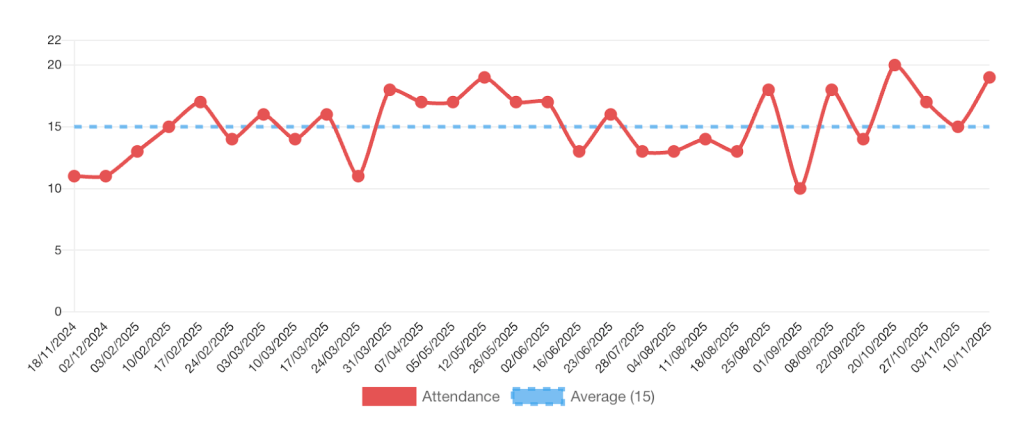
Attendance averaged at 15.
Notes:
- Though the group ended with 26 members, we began the year with 15.
- One member never attended due to mental health struggles, though we continued praying for him.
- One member became a small-group leader elsewhere and therefore never attended (and we prayed for her too).
- One member was away for extended periods of time due to other commitments which she disclosed to the group.
- Two couples had disrupted attendance due to family issues.
Despite concerns that a larger group might encourage people to skip, attendance held steady. The tiny-group structure likely contributed significantly.
Spiritual Assessment:
We surveyed members at the start and end of the year. We stressed this was to measure group effectiveness, not to score their discipleship.
- How often do you read the bible for yourself in the week?
- How often would you be praying for others in the week?
- Are you serving in a formal sense at church at the moment?
- On a scale of 1 to 10 how connected are you with the community at the moment?
- On a scale of 1 to 10 how would you rate your relationship with God?
| Baseline | End of Year | |
| Reading the Bible | 4.3 | 5.45 |
| Prayer | 4 | 5.3 |
| Serving | 6 | 8 |
| Connected to the group | 6 | 7.2 |
| Relationship with God | 7 | 7.18 |
Every metric increased, though some more than others. Some of the rise likely reflects the impact of new members joining, but the overall movement is encouraging.
We also asked at the end of the year:
How are we going as a larger group? — 8/10
How is your Tiny Group going? — 7.27/10
Observables
There were also some observables that we were hoping to see:
- 5 people invited their friends to church
- 5 People express that they feel more connected
- People are connecting outside the Monday meeting
- Two events of service outside of the group
“The groups that prioritized something other than building relationships and growing spiritually actually showed the greatest spiritual growth.”
— Leading Small Groups That Thrive: Five Shifts to Take Your Group to the Next Level by Ryan T. Hartwig, Courtney W. Davis, et al.
Outcomes:
- No one invited friends to church as far as I could see, though acedotally I did notice people were making an effort to talk to friends and coworkers about the gospel.
- Several members reported feeling more connected.
- Many people connected outside the Monday meetings — in twos, threes, and even larger hangouts.
- No formal service events occurred (likely my failing as a leader to create opportunities), but people still provided meals and care informally, which had a strong impact on community life.
Unexpected consequences
- As the leader, I often didn’t know what was happening in other tiny groups. I had to learn to trust the structure rather than micromanage.
- New people were integrated far more smoothly and quickly than expected.
- In Term 3 we tested how members adapted to leading the teaching block. Leading a seminar-style group of 25 is very different from facilitating a group of 8–10 — but most made the transition well.
- The large group size meant that absences didn’t kill momentum. People didn’t walk in and think, “Why did I bother coming?” — because the room still felt full.
- The teaching moment is still not smooth and I think some members have struggled to adjust.
Assessment:
Overall, this experiment was a success. The group functioned well, community was strong, people grew spiritually, and teaching effectiveness remained high.
A group of 25–26 with tiny groups seems not only viable but promising.
Implication: We may be able to shift leadership ratios from 2:8–10 to 2:23–28. This reduces the number of leaders required for small groups and frees leaders for other ministries.
 Peter D Hughes