We’re about to dive into some thought experiments about church. But before we do, let me lay down a few foundations to explain why. If you’ve found yourself directed here after raising an eyebrow at something I said, this is probably why.
There are two key reasons we need to think more deeply about church.
First, church is a doctrine we do. Not every doctrine is like that. We don’t do the Trinity. We don’t do atonement. Those doctrines have profound implications, but church is one we actively live out. It’s embodied in our gatherings, our relationships, our structures. So we need to think carefully about what we are doing and not merely react or inherit what has been done before.
Second, many of us from a reformed background have inherited rich doctrines—things like the authority of Scripture and salvation by grace. But when it comes to a doctrine of the church, the Reformers didn’t leave us with as much. That’s not really their fault—it just wasn’t their main focus at the time. But it is ours. We need to take responsibility for thinking well about church today. In fact, I’d argue that many of the issues we face in church life stem from not having a clear or shared understanding of what church actually is.
Thought experiments are one way to help us do this.
Now, before we get into the thought experiments themselves, here are a few things to keep in mind:
1. Thought experiments are hypothetical.
Take the classic trolley problem, one of the most famous thought experiments in ethical philosophy. A trolley is hurtling down a track where five people are tied up. If nothing changes, it’ll kill them. But you’re standing next to a lever that can switch the trolley onto a different track—where one person is tied up. What do you do?
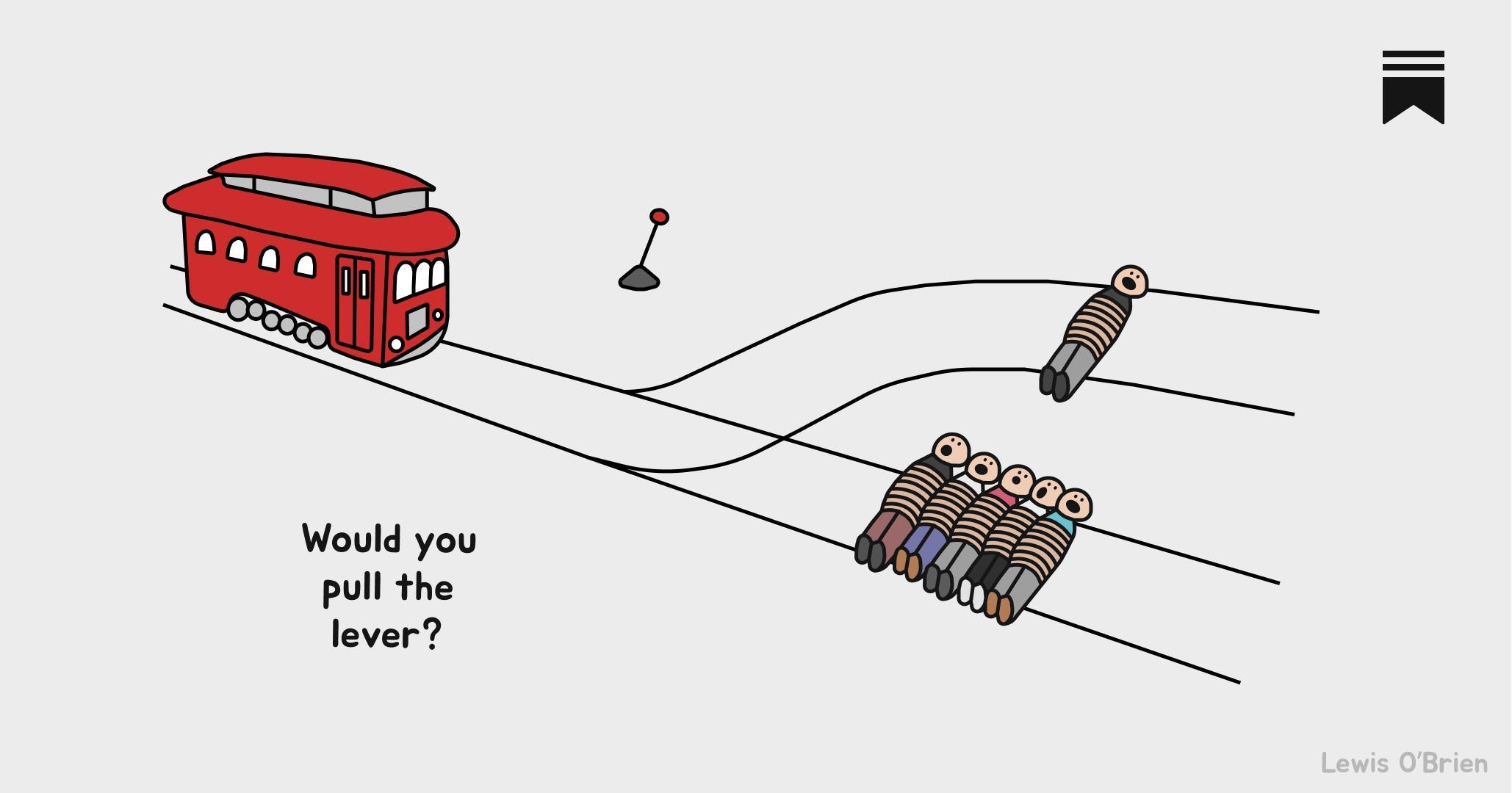
Most people say they’d pull the lever to save the five. But remember: this is hypothetical. You’re probably never going to be in that exact situation in real life. And that’s the point—it’s not about realism, it’s about what it reveals in our thinking.
2. Thought experiments are for thinking.
They push us to wrestle with our assumptions. There are variations on the trolley problem, like this one: the five people are still tied to the track, and there’s still a lever to save them—but now the track loops, and the trolley just keeps coming back.
Do you stay and keep pulling the lever every time? Or do you eventually walk away and let the five die?

Fewer people say they’d keep pulling the lever. Why? What’s changed?
3. Thought experiments are absurd.
There’s always a bit of ridiculousness built in. One variation is the “fat man” version. This time, instead of a lever, you’re standing on a bridge over the track with a very large man beside you. If you push him onto the track, he’ll stop the trolley and save the five people—but he’ll die in the process.

It’s absurd when you stop and think about it: Who is large enough to stop a trolley, but small enough for you to push? Still, almost no one chooses to push the man. And that tells us something interesting.
So with that in mind, let’s jump into a series of thought experiments about church—and see what they reveal.
 Peter D Hughes
[…] value in using analogies and thought experiments. They help us slow down and think more clearly. They surface assumptions we may not even realise we […]
LikeLike
[…] a simple thought experiment: what if there were as many churches in your area as there are […]
LikeLike
[…] if that’s the role of the Church? Come with me on a thought experiment on […]
LikeLike